
Cold Boot Attack: Farewell Disk Encryption
Colorful Night of Digitalization on July 1, 2022
aramido GmbH, Durlacher Allee 77, 76131 Karlsruhe
SWR Aktuell Podcast from June 8, 2019
Secure Data through Disk Encryption?
The CEO of a large technology company is on a business trip. He is sitting at the desk in his hotel room, finishing the day's emails before meeting a business partner for dinner to discuss details of an upcoming deal. The CEO closes his laptop screen, and shortly thereafter, a slowly blinking crescent moon informs him that the laptop is now in sleep mode. Later, when he returns, he wants to finish writing the last email and continue where he left off. The laptop is equipped with the latest technology: a TPM chip, along with a PIN required for startup, ensures disk encryption. It is company standard to use a secure password for logging into the operating system, supplemented by a hardware token. The security of the data is of paramount importance; if it fell into the wrong hands, the deal could fall through.
Attack on the Working Memory
After the businessman leaves the hotel room, everything happens quickly: strangers enter the room, tamper with the laptop, and copy the confidential documents . They leave the place exactly as they found it; only the laptop is now powered off. When the CEO returns after his successful dinner, he is surprised to find his device powered off – presumably the battery was empty. He connects the power supply, boots his laptop, and finishes his email.
How such an attack can occur was already demonstrated by researchers at Princeton University as early as 2008. They exploited the property of RAM modules not to lose all information immediately when power is disconnected. Data in the working memory persists for a few seconds to several minutes due to temperature-dependent remanence. The warmer the component, the faster the information is lost. If the component is cooled to minus degrees, data structures can persist for minutes.
The working memory contains numerous interesting pieces of information. For example, data from open programs are stored there. Similarly, the cached key for disk encryption can be found. To obtain this information, the researchers cooled the RAM of an open laptop with liquid gas, disconnected it from power, and then restarted it. During this startup process, however, they did not start the normal operating system, but a specially prepared operating system to read out the working memory and search for the disk encryption key. This attack became known as the Cold Boot attack.
Second Generation Cold Boot Attack
In the years that followed, a mechanism was invented to protect against such cold start attacks: as soon as the operating system places a key in the working memory, the computer's firmware (EFI/UEFI) is instructed to erase the working memory during the next startup before any operating system is started. This instruction is known as Memory Overwrite Request (MOR). This made the 2008 attack obsolete, as reading the working memory would merely produce a collection of zeros.
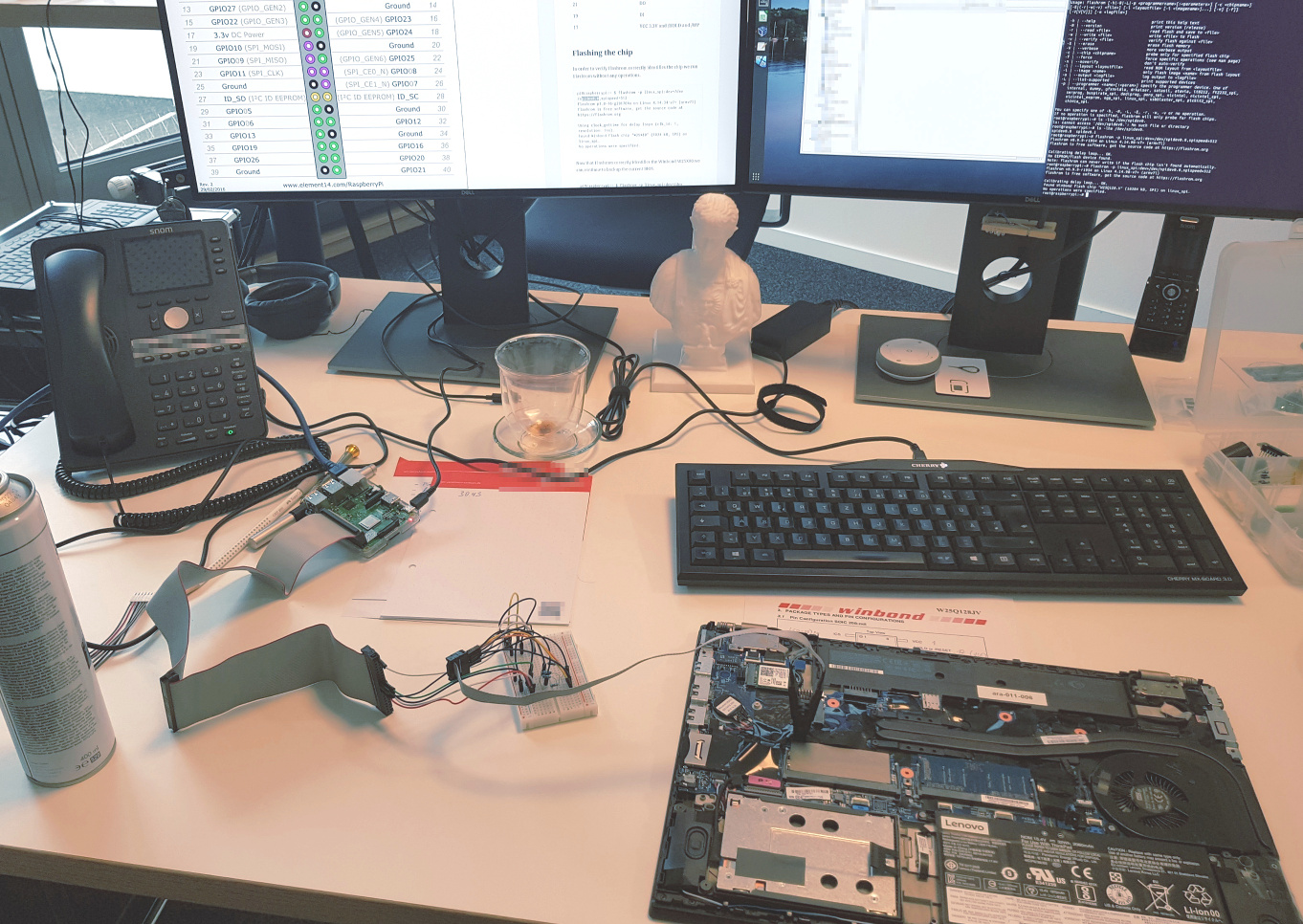
Ten years later, the Cold Boot attack was further developed by Swedish researchers by adding an additional step. After the computer is powered off, the firmware is now additionally manipulated. The Memory Overwrite Request previously requested by the operating system is reset. As a result, the firmware will no longer erase the working memory. The attack then proceeds according to the 2008 plans.
aramido demonstrates Cold Boot Attack
For aramido's security researchers, such attacks are part of their interesting toolkit. For this reason, they reconstructed the operating system that reads the working memory. Additionally, a script was developed to manipulate the microcontroller. The simulated attack was presented in April 2019 at the Karlsruhe security initiative, of which aramido is a new member.
Protection against Cold Start Attacks
The working memory contains not only cryptographic keys in plaintext but also data from currently open programs. To protect them during readout, the entire working memory would have to be encrypted. This would not prevent the readout itself, but attackers would be unable to make use of the ciphertext. Such protection is currently being developed and requires efforts from both hardware and software developers.
Until devices resistant to the current version of cold start attacks are on the market, mitigating measures can be implemented:
- Use of disk encryption
- Configuration of Secure Boot
- Setting a firmware password
- Disabling boot from unknown media

On 09.10.2019 in the category Data Security published.